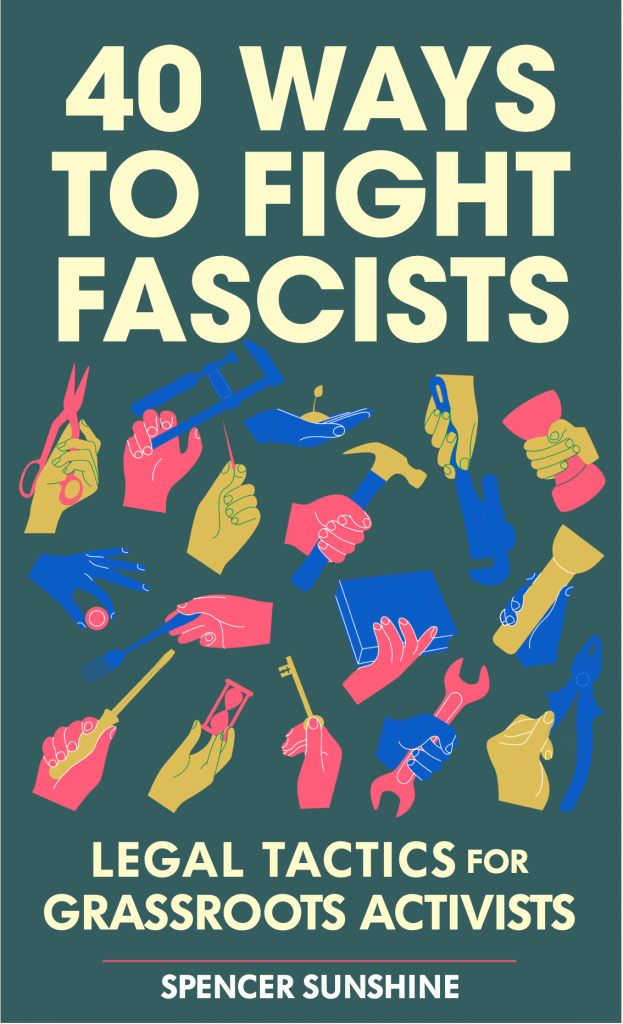
The new, third edition of the 40 Ways to Fight Fascists is finally out! First issued in 2018, the 2020 version has become the most popular organizing guide of its kind. It was translated into different languages and has a print-ready version which are all available here.
This new version has been released by Micocrosm Publishing; it is printed in offset and has a color cover. I have donated my profits from it, but the press still has expenses (printing, staff wages, etc) to produce this, so if you would like individual physical copies of these, and your local bookstore doesn’t stock it, please buy them directly through Microcosm. If you would like to distribute bulk copies, please contact me directly as I get a deep discount. Additionally, a print-ready, updated version will be available in the future at this spot; contact me if you would like to be put on the notification list for that.
If you would like to support my work researching and helping counter fascism and the far right, please consider signing up for my Patreon. I am not funded by any universities, think tanks, security services, or the deep state! Since 2018, I have spent an untold number of hours working on this guide, which I have don’t make money from and have done my best to make widely available. Patreon supporters also get exclusive content and updates on projects.
From the back cover of 40 Ways to Fight Fascists
Need effective strategies for combating fascism in your local community? Make an action plan with this guide to legal, practical, and community-based ways to fight back. As the current administration cracks down on activism to feed their fantasy of “antifa terrorism,” this zine gathers together dozens of tactics that just about anybody can use to help disrupt fascist organizing, with something for everyone—no matter your background, identities, or skill set.
Whether you’re up against a pastor who spreads Christian nationalism during sermons or Nazis marching in the streets, this no-nonsense, pocket-sized resource will empower you and your community to curtail fascism’s spread, disrupt Far Right activities, and hold participants accountable. You’ll find guidance on everything from infiltrating online groups to organizing counter demonstrations, along with a glossary of terms and a reading list of further resources. Start where you are, and remember: together our communities can resist fascism!
40 Ways to Fight Fascists: Legal Tactics for Grassroots Activists, 3rd edition
ISBN 9781648418662
Microcosm #1220
Introduction
Nazis ruin everything. They come into our communities, organizations, and social media to spread hatred and lies. And once they get their claws in things, they are hard to get out. They don’t just spread bigotry, turning us against our neighbors, but wherever they go, violence always follows—whether it’s attacking people in the street or committing mass murder.
But you and those in your community can help stop this. A lot of people think that the only way to oppose fascists is by punching them—but this isn’t true. In fact, most of the tactics used to oppose them are fully legal, despite the Trump administration trying to scare away people from using these legal strategies.
This guide walks you through forty legal, practical, and community-based actions that have been used for years. Many of them can be done by people from all backgrounds, identities, and skill sets. Together, these diverse tactics will help contain fascist organizing and limit the damage it does.Two notes of warning: Fascists are very aggressive, and they are not shy about using violence to achieve their goals. So do not hesitate to use all options at your disposal to keep both you and your community safe.
Second: This guide is specifically made for activists in the United States, and refers to its laws, although much of it will be useful elsewhere. However, as this new edition is being prepared in mid-2026, the Trump administration is doing everything it can to conjure up an imaginary organization called “antifa.” The administration then plans to manipulate the law in order to treat a wide range of activists as if they belonged to a terrorist group. However, at this time all of the tactics in this guide are legal, and should remain so, regardless of what they want. But pay close attention to any changes in the law, especially regarding doxxing or having contact with certain groups.
Who is the Far Right?
The first edition of this guide was also originally written specifically about fascists, like neo-Nazis, as well as other White Supremacists, who use or threaten violence as part of their political approach. (See the glossary for the definition of these terms.) However, those who used the guide found these tactics useful against a much broader section of the Far Right, especially more politically moderate groups that may include people of color, but still use violence, like the Proud Boys and militias.
Fighting fascists is complicated work. There is a learning curve, and it is potentially dangerous. So make sure you are fully prepared before starting!Unlike open White Supremacists, these other Far Right groups are usually less extreme in their beliefs—although not necessarily in how they act. They usually stop short of open racism, and many allow people of color, Jews, and sometimes gay men to join. But they still spread conspiracy theories and coded racism, Christian nationalism, antisemitism, Islamophobia, homophobia, transphobia, and misogyny. Often they present themselves as patriots so they can hide their anti-democratic, authoritarian politics. Sometimes they will drop their masks and collaborate directly with fascists.
Therefore, this guide has tried to make a distinction between the larger Far Right in general—which includes parts that do not use open violence—and fascists in particular, who as a rule do. But because language is difficult, when “fascists” is used in this guide, it will usually refer to both traditional fascists and these violent Far Right factions.
However, your approach cannot be “one-size-fits-all,” and you will have to figure out what the most effective tactics are for each situation. How to deal with a pastor who is spreading Christian nationalism during his sermons will be different than what to do for Nazi skinheads marching in the streets. Know your enemy.
Glosssary
Charlottesville was the largest fascist rally in the United States since 1939. Held in Charlottesville, Virginia on August 12, 2017, the evening before was marked by a torchlight march where “Jews Will Not Replace Us” was chanted. The next day, after street-fighting with counterprotestors, a neo-Nazi car attack left one dead and almost 30 injured.
Christian Nationalism is a political movement that seeks to seize power so that it can force its religious views on all parts of society.
Deplatforming is getting someone or something removed from an online platform or app, such as social media, financial services, web hosting, or even dating apps. In the past, this has been an important tactic used against White Supremacists.
Doxxing is publicizing the personal information of someone, which may include their address and phone number. (This is different from merely identifying someone and connecting them to public information.) Like deplatforming, this is also an important tactic used against White Supremacists.
Far Right is a term that covers all of the different types of politics in this glossary, from militias to genocidal neo-Nazi terrorists, and is to the right of liberal democracy on the political spectrum. Far Right groups don’t always have the same views, but they all want to see an unequal society where the control by some types of people—usually white, straight men—is seen as natural and desirable. They oppose democracy, egalitarianism, and the Left; support patriarchy; use conspiracy theories to understand the world; and demonize “others”—whether this is about race, ethnicity, gender, religion, or politics.
Fascists follow a particular kind of violent Far Right politics that sees society as in decay and wants to have a reactionary revolution to create a new society. There are different kinds of fascists; while some define themselves as nationalists and accept people of different races, most others seek racial purity—especially National Socialism, the most extreme form of fascism.
Misogyny is the hatred of women. While it pervades all of society, it has many more organized forms, especially those that make up the “manosphere.” The best known type are incels (involuntary celibates), but politicized misogyny can be found across the Far Right. Neo-Nazis believe in National Socialism, the belief system of Adolf Hitler’s Nazi Party. In the United States, neo-Nazis are typically the most extreme White Supremacists and have a particular focus on antisemitism. They are also the most violent faction and want to create a dictatorship where they rule by force. Note that while neo-Nazis are the best-known type of fascism, there are other versions as well.
Neo-Nazis are postwar followers of National Socialism, the belief system of Adolf Hitler’s NSDAP (National Socialist German Workers’ Party)—what we call the Nazi Party. In the United States, neo-Nazis are typically the most extreme White Supremacists and have a particular focus on antisemitism. They are also the most violent faction and want to create a dictatorship where they rule by force. Note that while neo-Nazism is the best-known type of fascism, there are other versions as well.
White Supremacists are those who want to form an all-white country and usually hate people of color, Muslims, Jews, immigrants, and LGBTQ+ people. They may want to make these groups into second-class citizens, or they may wish to expel or exterminate them. Note that this guide uses the term “White Supremacist,” in capital letters, in the narrow way defined here. This is different from how this term is also used to describe how racism is found in almost all parts of our society.
I. Starting Out
Fighting fascists is complicated work. There is a learning curve, and it is potentially dangerous. So make sure you are fully prepared before starting!
1. Learn about the Far Right
The first thing you need to do is learn about movements, its members organize around specific issues, spread talking points, form organizations, make media, forge alliances, fundraise, recruit new members, and try to influence the larger society. Learn how they are doing this.
From the outside, the Far Right may seem like a single bloc where everyone holds the same beliefs and works together. In fact, they often disagree with each other and have trouble finding common ground. Knowing how they’re different is important in deciding how to organize against them.
There is a lot of information available that explains the Far Right, and there are suggested readings at the end of this guide. You’ll need to learn the main groups—and their ideas, talking points, and tactics—so you know them when you see them. Pay attention to their differences, too, because how they relate to each other is important: for example, militias will almost never work with neo-Nazis.
Far Right groups know their ideas are seen as hateful, and the more extreme ones in particular will use images, phrases, and slang to express their ideas without being upfront about them. This tactic is known as using “code-words”or “dog-whistles.” Learn their language.
A word of warning, however: some people are traumatized by looking at this material, especially the more extreme stuff, such as videos of massacres, or when the watchers are people who belong to historically oppressed groups. Know your own limits. There have even been cases in which researchers have gone over to the other side and adopted Far Right ideas. So, especially if you are just starting out, consider doing this work with others who can help with any issues that come up.
2. Find Others to Work With
While there are national organizations that watch the Far Right, they can’t track everything going on everywhere. That’s where you come in. But don’t jump into the fight alone! One person doesn’t win against a mob, and this kind of activism is a lot of work, so it’s best done with like-minded people. Try to form a group, although you may find that there are already people in your community working on this. If it’s possible to work with larger organizations or coalitions, you will be able to get even more done.
Since there is more than enough work to go around, coordinate with others. This should prevent reinventing the wheel, allowing you to specialize and focus on your strong points.
3. Set Up Security
It is absolutely crucial that you set up both physical and online security before you start this work. One of the most dangerous things is to fail to do this, especially when it comes to your online security.
In all cases, anonymity is the single most important protection. So keep a low profile and try to limit who knows what you are working on, even if you are already a known activist. No one needs to know that you doing this particular work. Loose lips sink ships!
Begin by cleaning up and locking down your online presence. This includes social media, but also other things you don’t usually think about, such as Amazon reviews. Remove pictures or information that could help someone figure out where you live—and things that connect you to family, friends, or work. Consider getting a private mailbox. Download a good VPN, the secure Tor browser, and the encrypted messaging app Signal.
If you do get identified and your personal information is shared publicly—called “doxxing”—immediate precautions need to be taken to secure your digital and real-world life. Some suggested guides can be found in the back.
You should also think about your physical safety and security, especially where you live. It is easy to make idle threats online—but sometimes they are real. Follow standard security advice for preventing break-ins, which may include setting up locks, alarms, cameras, and outdoor lighting. You should also plan on who you’ll contact in an emergency, especially if it is not the police, and set up an escape plan.
4. Observe and Document
Once you’ve found people to work with and have your security set up, it’s time to start watching the Far Right! This is the bread-and-butter of most groups, and it is in your own community where you can have the most impact.
First, figure out who is active in your area. There are several ways to do this. The Southern Poverty Law Center’s annual “Hate Map” shows some groups, but there are many other local and regional groups, websites, and social media accounts that provide this information as well. You can also look at stickers and flyers in your area and search for news stories covering rallies or conducting interviews.
Next, start gathering evidence about them. Document their organizations, projects, social media, websites, print publications, meetings, and events. Be sure to take good notes and screenshot everything—little things can end up being very important later on. The more extreme end of the Far Right tends to organize under the radar, so this will require a good bit of sleuthing.
First, use OSINT (Open Source Intelligence), which is just looking at publicly available information. Check for social media, websites, Substacks, podcasts, and videos. You may also want to read an OSINT guide or take a class. Install Telegram, a secure app for individual and group messaging that is a favorite of fascists.
Then, on each platform where the groups you are tracking are active, create a fake social media account. Known as a “sock puppet,” this is your undercover identity. It is the most important tool for online infiltration, so craft your identity carefully.
Your sock puppet will be needed to get into closed groups, where they tend to be the most open about their plans and the most vicious in their language. Don’t say or do anything that looks suspicious, could be used to identify you, or could cause you to lose access. And definitely do not do anything that encourages violence.
Often, people who come from historically oppressed groups think that they can’t do the work of watching the Far Right. While some people find it too upsetting to do it, on a logistical level anyone can. Today, almost all of this is done both anonymously and online, and many people engaged in this activism are from these identities. Nonetheless, occasionally there is in-person infiltration, which is obviously dangerous. This should only be carried out after careful planning and, ideally, first talking to experienced people.
The goal is to collect information like fake and real names, pictures, home addresses, jobs, social media accounts, criminal records, organizational affiliations, and political events they have attended. It is also very important to keep an eye out for anything about violence, especially planning it or admitting to it.
Pay careful attention to rallies and other public events. Sometimes these are livestreamed by either the groups themselves or people watching them, and this adds to your safety and anonymity. Arrest records are also public, and therefore an excellent way to collect information.
Do your best to make copies of everything; remember that even publicly posted material can suddenly be taken down. You’ll quickly amass a collection of screenshots,
PDFs, audio, and video, so make a plan for how it will be labeled and stored. It’s ideal to back up websites and other things with URLs on archive.org. But these can be taken down too, so try to also put them on similar sites, like archive.ph. Having a system to do this will work wonders.
II. Getting Ready
5. Recruit Early and Often
Opposing fascism requires many people with different skills. Try to recruit these ahead of time, instead of scrambling when it’s urgent. There’s always a need for graphic designers, therapists, lawyers, legal observers, journalists, translators, techies, writers, content creators, and trained de-escalators. Many people who can’t be on the frontline might be able to give a dramatic haircut or professionally paint a car for someone in danger. These may feel like small contributions, but they can be very important in an emergency.
6. Find New Allies
If fascists are organizing in your community, take this opportunity to make connections outside your usual circles. Because fascists target so many different kinds of people, this creates an opportunity to make alliances you would not normally have. These allies might include groups representing people from historically oppressed identities (including people of color and LGBTQ+ people), immigrant and refugee rights organizations, religious groups (especially Muslims and Jews, but also Christians), feminists and reproductive rights advocates, labor unions, and organizations that memorialize historical crimes such as lynchings, the Holocaust, and Native American genocide.
While trust can be built through shared work, someone has to reach out first. Be upfront about who you are and what you hope to achieve. You should also find out what these groups and communities need. It won’t necessarily be what you think—or are ready to give. And don’t be surprised to find that there are conflicting agendas both within and between communities. Spend time getting to understand their concerns.
7. Develop a Communications Strategy
More and more, politics are won and lost on social media, podcasts, and videos, so create a communications strategy. What is the message you want to get out? Identify what platforms your audience uses and find sympathetic con tent creators. Meanwhile, in-person events require speakers, planners, publicists, and security. If you don’t have access to the people you need, help supporters develop these skills. (But remember that visible figures will lose their anonymity and could become a target.) And, if you have the capacity, don’t forget to reach out to communities that speak other languages and which may be targeted by the Far Right. Find translators and figure out how to communicate your message.
8. Fundraise Before You Need It
All political movements need money, whether it’s for transportation, art supplies, media expenses, or arrests. Try to do this before the need arises; fundraising can be time-consuming and will slow you down if you need the money at a crucial time. Public fundraisers, like concerts and talks, can double as outreach opportunities. And consider making merchandise with your message on it, which is also a good way to get artists involved. Stickers are especially useful, as they can be used to cover up Far Right propaganda, but buttons, patches, and coffee cups are popular as well. Be sure to figure out who will hold the money and how they will be accountable; infighting over funds has plagued many groups.
9. Form an Emergency Response Team
Violence is central to fascism, so if fascists are organizing in your area—there will be emergencies. You will also get last-minute calls when they hold unannounced events, which has become their standard way of doing things. Set up an emergency response team that can jump into action at a moment’s notice. Ideal skills include medic training and self-defense, but there are many situations that don’t involve responding to violence; for example, teams can also organize rides for people who feel threatened. But again, remember that showing up in person can compromise one’s anonymity.
If fascists are present, try to collect information using the SALUTE model, especially before an emergency team goes out, so they know what they’re getting into. SALUTE stands for: SIZE (how many are present?), ACTIONS (what are they doing?), LOCATION (where are they specifically, and are they moving in a certain direction?), UNIT (can you identify them by their badges or uniforms?), TIME (when was this information gathered?), and EQUIPMENT (are they carrying weapons, flags, or banners?).
10. Find a Safe Place
The Far Right loves to make threats, and online anonymity has made this very easy. Government officials and influencers with large platforms, like Libs of TikTok, often single out political opponents, knowing full well that, even without explicitly calling for it, their followers will hammer the person identified with death threats. Sometimes this becomes so bad that people have to flee their homes without much warning. So be sure to have someone not known to the Far Right, and that can be contacted at all times, who is always ready to provide a safe place to go to.
11. Getting Along
In the big picture, everyone who opposes fascism is on the same side, and these politics need to be a big tent. While it’s normal and healthy to debate and disagree, publicly dragging each other helps the Far Right. They frequently publish dirt on each other during personal or tactical disagreements. This behavior shows us their weak spots, and publicizing it makes it harder for them to work together. So don’t let them take advantage of this dynamic when it happens on our side! Instead of airing conflicts in public, discuss your issues directly.
If you’re organizing with communities and political movements that don’t usually work together, tensions are more likely. Make a sincere effort to get to know other activists, form coalitions, and build mutually respectful relationships based on your shared desire to oppose fascism. If you can’t work your problems out, consider bringing in an outside figure, such as a mediator. But, if in the end you can’t get along, do your best to live and let live. Disagreements are inevitable—drama is not.
III. COMMUNITY WORK
12. Hold Memorial Events
Almost all communities have histories of White Supremacist and other Far Right violence. Put on events memorializing the victims and talking about how past events contribute to the present. Examples include holding memorials where people were murdered or having processions to where they are buried. You can also organize commemorations remembering public acts of violence, such as lynchings, church bombings, and racial expulsions. But be sure to talk about the lives of those killed, so they are not just remembered as victims. When possible, talk to their families and communities to see if they want to participate, or if there are specific ways they do memorials.
13. Build Educational Programs
Organize public talks, reading groups, and classes. You can discuss what the Far Right is, how it functions, and what you can do to resist it. This is a great way to find people with similar interests. While online events are typical, in-person events are also useful in different ways, and many experts are available to give talks.
14. Refute Their Lies
Fascists are skilled at introducing slogans and talking points into public discussion. These include myths and false information about “white genocide,” the “great replacement,” and black-on-black crime, as well as Holocaust denial, lies about trans people and Muslims, and conspiracy theories about “antifa” and the supposed Jewish control of the media. While debating these groups publicly can make their arguments look worthy of consideration, circulating a list of common talking points—along with rebuttals—gives community members tools to win arguments in private settings. And when people with bigoted views are in a space of doubt and self-questioning, the facts will be ready for them to discover.
15. Organize Trainings and Resource Fairs
Trainings are a good way to draw attention to fascist organizing and equip communities with useful skills. These might include first aid, disaster response, personal and digital security, bystander intervention, and conflict deescalation. These trainings can also function as outreach opportunities and places to find people who are serious about doing concrete work.
16. Form a Martial Arts Club
Fascists have established extensive networks of MMA (mixed martial arts) clubs. For example, the Active Clubs have almost two hundred chapters around the world. This makes their movement all the more dangerous. But, worse, these clubs also draw in young people who are not committed to fascist politics, but are looking for a place to train—or just seeking community.
But you can build an alternative to this phenomenon. In Europe, left-leaning martial arts clubs are common, although there are only a few in the United States. A resource about organizing these can be found in the back of this guide.
Forming your own club provides a good way for activists to stay in shape, get trained in self-defense, and develop confidence. But they also give an alternative to those just looking for something to belong to, who might otherwise float towards the fascist ones. (You can also do the same thing with sports supporters clubs such as soccer, where there is a similar dynamic. Fortunately, there are already a number of these in the United States!) Establishing a competing alternative is part of the idea of the “contested terrain.” Communities have both reactionaries and progressives in them, and these two currents compete to win people over to their politics. If fascist recruiting is not challenged, it wins by default.
17. Weapons Training
While many of this guide’s activities fit well in other countries, the question of guns is specific to the United States. And even here, carrying firearms at public events is controversial. However, regardless of how one feels about it, it is already being done, and so a sober discussion of this is needed.
In situations where it is legal, consistent with your beliefs—and where you believe it is truly necessary—you may consider being armed at public events. But there are many preparations and legitimate objections to be dealt with first. While in recent years this has been an effective approach that has saved lives in some situations, in others innocent people have died.
Guns are difficult to use and require a lot of training. If you will carry one at a public event, you must know the law, scrupulously follow it, and spend time training as a group. (Be aware that armed groups are known to attract undisciplined people.) And since carrying weapons is almost always contentious, try to work out potential problems with organizers before the event.
This tactic can be useful, especially when the Far Right groups like militias are already engaged in armed intimidation, such as during the drag show protests in 2022 and 2023. But when activists showed up to defend the drag shows while armed, those who came to intimidate them almost always backed off. A more extreme example was in 2022 at a Black Lives Matter protest in Portland, Oregon, when a Far Rightist opened fire unprovoked, killing one and wounding several others (including another who later died). This mass shooting was stopped by an armed member in the crowd.
Other examples were disasters. In Salt Lake City in 2025, an armed activist came to join an anti-Trump demonstration. The security team misread the situation and opened fire, killing an innocent bystander. The same year at a demonstration against ICE (Immigration and Customs Enforcement) in Prairieland, Texas, a police officer was shot and wounded. The shooter was convicted of attempted murder and received a 100-year sentence, while a number of others received 50 to 70 years for convictions that included Texas state terrorism charges. And in 2026, a legally armed activist in Minneapolis who was taking part in a protest was shot to death by ICE agents.
IV. TAKING ACTION
18. Release Your Research
Releasing information about local fascists lets their events and propaganda campaigns. Be sure to high- light violence, threats, and arrests. Sharing this information can take different forms, including in-depth articles, formal reports, or be published on a blog or social media account set up for this purpose. You may also try to feed this information to journalists who have access to much bigger media platforms. But you will need to build a relationship first and make sure you can trust them. But first always discuss issues of anonymity and what can be published.
A note of warning, though: sensationalism or too much coverage can actually help fascists. And if you reproduce their graphics or photos of events, remove any contact information and deface the images so they can’t be reused by them as propaganda. Don’t signal boost them!
19. Put Pressure On
If the information you release identifies individual fascists, make sure it gets widely seen. Exposing them can have a major impact on their lives, and traditionally this has been one of the most important techniques to use. Even if you don’t see it right away, years down the line their actions can come back to haunt them. The largest fascist rally in decades was held in Charlottesville, Virginia in 2017, and for many years afterward, attendees were still being identified and charged with felonies.
There are a few different ways to apply pressure. You can call their work and ask them to fire the fascist in their midst; notify their neighbors with letters, flyers, and door-knocking campaigns; and ask local businesses to refuse to serve them. In the past, demonstrations have been held outside their homes.
But be warned that, as this edition was prepared mid-2026, several potential changes are in motion. Groups and politics which used to be considered taboo by the mainstream—such as militias and Proud Boys—have become acceptable in some right-wing circles, as has, in some cases, sympathizing with the Nazis. So your mileage for how effective this tactic is depends on how liberal your community is, and the kind of company the person works at.
There is also the more intensive practice of “doxxing”—publicly revealing personal information, such as a home address or phone number. A September 2025 memorandum from the Trump administration, which outlines how it will attack its opponents on the Left, claims that “organized doxing campaigns” are “politically motivated terrorist acts.” But while these words are threats, they are not laws. However, doxxing government officials and their families is illegal (18 U.S.C. § 119), and so this guide does not endorse this. Additionally, some states have their own anti-doxxing laws. If you have questions, consult a lawyer. But note: although sometimes conflated, merely identifying an individual is not doxxing.
20. Deplatform Fascism Online
Just like everyone else, it is difficult for the Far Right to function if they can’t be online. In the past, deplatforming them has been very effective. (Deplatforming is getting an account removed from an online platform or app.) However, this has become much harder as the Far Right has taken over more and more media platforms. After Elon Musk bought Twitter and turned it into X, it became almost impossible to get bigoted political content removed from there. But it is still possible on others like Bluesky and YouTube, although it may take widespread reporting. Rideshares and dating apps are also sensitive to these issues. Financial platforms like GoFundMe, Venmo, and PayPal can be pressured as well, and these are especially important because it cuts off funding sources. Amazon is a mixed bag; books that are removed are sometimes re-added soon after.
When attempting to deplatform someone, make appeals to the Rules of Service of the platforms in question—although how these actually are enforced is almost never public and appears to often change. Always stress threats of violence, images of child sexual abuse, and fraud. It is the last two that are the most likely to be acted on.
21. Get Events Cancelled
The First Amendment of the U.S. Constitution guarantees that the government cannot interfere with protected speech. But private citizens have no obligation to let fascists use their property, and you also have a First Amendment right to ask conference spaces, concert and lecture halls, galleries, and restaurants to refuse these kinds of rentals.
Sometimes these venues will refuse to cancel a fascist event out of greed. In this case, organize a call-in campaign to push for a cancellation. If necessary, threaten a boycott, and be sure to follow through if the event goes ahead. If a local venue experiences a fallout from this, others will be easier to convince in the future.
Don’t forget to offer support to businesses that choose to do the right thing, such as public praise or encouraging people to patronize them. If fascists make threats after an event is canceled, offer escorts for the employees going home after work. If the space is vandalized, create a fundraiser to help cover cleanup costs.
22. Remove and Replace Fascist Propaganda
Don’t let the fascists claim any ground! They often put up flyers and stickers around college campuses, residential neighborhoods, and bars and clubs. Remove these as soon as you can and replace them with your own. If you already made stickers, now is when to use them! This lets fascists know that people are watching and ready to oppose them, while letting targeted groups also know that others in the community have their back. And do this even in conservative areas; even if it’s not immediately obvious, every community has a diversity of political opinions and identities.
23. Support Targeted Communities
Fascists are always looking to get their claws into a wide variety of spaces. They have recruited from soccer supporters clubs, online gamers, music genres and subcultures (especially black metal, neofolk, punks, and skinheads), and different religions (including Heathens, Satanists, and Christians). Fascists may also focus on a specific neighborhood, church, or school.
There will always be community members who push back, and usually they are in the best position to do so. They know how to speak the community’s language, what the discussions are, and where is best to engage. Find them and ask what kind of support they need.
Fascists are also known to target left-leaning projects, either so they can join in or just recruit from them. In the recent past, these have included anti-war protests, criticisms of the banking system, Palestine activism, radical environmentalism, and animal rights. Expose them and kick them out! And if the organizers have been warned and won’t do anything, make sure their actions are known as well.
24. Stage an Intervention
Pay attention if you hear fascist, conspiratorial, or other similar talking points from your family or friends. If you’re a teacher or a librarian, this may happen where you work. Basic political differences aside, if you hear White Supremacist slogans, biological racism, Holocaust denial, or similar extreme views—such as the language online child abusers use—consider staging an intervention. There are suggested guides in the back.
25. Prevent Uninvited Guests
Far Right provocateurs will show up to left-leaning events to spy or disrupt them. A favorite tactic is to film themselves antagonizing attendees in hopes of starting a fight, after which they will harass them or even try to get them arrested. So have a safety team, who are familiar with your local provocateurs’ faces, ready to intervene and try to de-escalate. If they are filming, whimsical barriers like hula hoops in bubble-wrap can ruin their footage. Playing loud, copyrighted music has even resulted in videos being removed from YouTube for copyright violation.
If the Far Right starts to disrupt your events, make sure the wider community knows, especially if they are using violence. This can signal the beginning of something larger.
26. Push the Mainstream to Oppose Fascism
Too often, the mainstream is quiet when it comes to local fascist organizing. So encourage elected officials, religious institutions, unions, community groups, and professional organizations to take a public stand. These figures and institutions usually have significant influence and can have a more powerful impact than activists or media. It is especially important to get them to speak up if they represent communities where fascists are active. And if they are present in these organizations or institutions, pressure the leadership to isolate or expel them.
27. Use the Courts
Both lawyers and governments can hamper fascism. If it is in line with your political views, and you have the opportunity, take them to court. Activists are generally wary of the legal system, but civil suits are different than criminal cases and do not involve police or prisons. There are many instances where large judgments have forced organizations to disband and property to be sold. In addition to lawsuits, you can also make sure their parole violations, building code problems, and tax evasion become public knowledge.
White Supremacists are particularly vulnerable to lawsuits because there are few sympathetic lawyers willing to defend them for free. Even if they win in the end, lawsuits can drag on for years and drain financial resources. But beware! This drain can backfire on you, and your information may be exposed during the legal process. So consider this tactic carefully.
28. Drive Wedges
When you see fascists and the more extreme parts of the Far Right trying to work with mainstream conservatives, reach out to them with your concerns. If you offer concrete evidence, some will disavow fascists who express clearly bigoted views or engage in violence. If they don’t, publicly draw attention to their collaboration. However, just as with deplatforming, as the political temperature has moved to the right this has become more difficult, as the bar for what is too toxic for mainstream society has become much higher.
You can also drive wedges inside the Far Right itself, since it’s filled with big egos and constant squabbles. (It is not uncommon for them to murder each other.) Help deepen divisions by publicizing infighting, especially when this happens inside of a group. Distrust is an effective way to disrupt organizing capacity. But be aware that the Far Right knows this too, and may use this strategy against you.
29. Help Fascists Become Formers
Fascists are part of our society. While it is possible to isolate individuals, the only way to actually get rid of fascists and other White Supremacists is to get them to leave their politics behind. (Despite lots of big talk about “killing Nazis,” in the United States there have only been two instances of Far Right activists being killed by their opponents in over 30 years.) But helping fascists leave can be a difficult process, and those who want to are often aided by “formers”—those who have left the movement already—who sometimes work with “exit programs” to help others get out. So encourage and help fascists transition into being formers. Ideally, this includes them publicly renouncing their views and making amends to injured communities. You can also help them get racist tattoos removed or go to therapy.
Some people will never be able to let go that these people were once fascists. While it is certainly understandable that everyone can’t forgive, on a practical level, it’s important that they at least forget and allow formers to go on with their lives. If they remain isolated because of their former views, there is a much higher chance they will return to their old ways.
V. IN THE STREETS
30. Consider How to Respond
The Left loves to march in the streets, and this includes counterprotests against Far Right rallies. Holding one within sight and sound distance of their rally can potentially deny them a high-profile public platform, attract support for your cause, and even overshadow them.
Today, however, White Supremacist rallies are almost always surprise “pop-up” events, giving you much less time to react. And most of those public Far Right rallies which are announced in advance are even more politically moderate, and may have people of color attending or even speaking. Because one size does not always fit all, ask before you organize: What is the right approach for this specific situation? Sometimes it may be useful to have another event at the same time—though not always. If they are marching, you can turn it into a pledge drive for the cause of your choice, with donors pledging money either per fascist or by how far they march.
However, if a counterprotest is called, even if you disagree with the decision, it’s important to get people to attend. A small counterprotest is a loss and, in more than one case, Far Right rally-goers have attacked and won the fight. If this happens, what you did was far worse than if you had ignored them, and gives them a green light to be even more aggressive.
31. Push Officials to Pull Permits
In some areas, permits to hold public events are required, especially for larger rallies. When fascists apply for them, pressure local governments to refuse or revoke them. This will be most effective if you can show evidence that they are planning violence.
32. Pressure Local Businesses and Rental Spaces
If there is going to be a fascist event, encourage local businesses to refuse service to those who are attending, including hotels, restaurants, and bars. Circulate pictures of known members, as well as symbols they might be sporting. And be sure to support those businesses that are on board!
33. Take Up Space
As you keep tabs on the Far Right, you will find out about their plans in advance. If you get wind of where they are going to be, occupy the space first. If they need a permit, apply for one before they do. Consistently thwarting their events may lead to them giving up on that strategy.
34. Organize!
If you’ve never helped organize one, large demonstrations are a lot of work! But they are also good places for people who can’t go into the street, because a lot of the work is actually in the background. Activate your communications strategy, find planning spaces, get permits and equipment, drum up excitement, fundraise, set up legal and communications support, and recruit street medics. Now is the time to use the relationships you have forged with other groups. If you make a regional or national appeal for others to come, help arrange transportation and housing.
Artists can help make political action more appealing. Ask them to donate art for fundraisers and make beautiful flyers. Recruit musicians and dancers to come to protests. Counter fascist messaging by being more vibrant, more entertaining, and more approachable than theirs. Make your actions into the party everyone wants to be at—and if you don’t know how to do that, then find a party promoter who can. But the Far Right will likely try to identify organizers, so take precautions.
And be sure to alert those who live and work near the event—especially when it’s where many historically oppressed people live. Use this as an opportunity to go door-to-door to talk with people. Be as kind, courteous, and genuine as possible.
35. Document Their Rallies
High-quality video and photography of those who attend Far Right events allows people to research individuals later and especially to document criminal acts. But be warned that getting clear images of faces is a lot harder than it seems. For years after Charlottesville, attendees have continued to be identified and even arrested, on the basis of grainy or obscured images. But do your best not to record any video of activists on your side. And remember, if Far Right activists realize that you’re recording their event, they may target you in turn—either during the event or after.
VI. Be Supportive!
36. Accompany People from Vulnerable Groups
Obviously, many historically oppressed people feel fear in their everyday lives when fascists are visible in their communities. This might be when they hold rallies, put up propaganda, or make direct threats. Ask people from these identities what they would like. For example, a common request is to accompany them in public, such as when they are going to work or the store.
37. Warn Those Threatened
Fascists are exceptionally violent, both in word and action. As you monitor them, you will inevitably discover them making threats. Be sure to warn their targets, while making sure your sources remain confidential. Support for those targeted might include escorting them or their family in public, running errands for them, and guarding their homes in case of an attack. (If you’ve established a safe place to go to, now is when it comes in handy.) Digitally, this may include helping to wipe their online presence or install security tools, as well as to investigate who is threatening them.
38. Take Care of Yourself and Your Friends
Even in the best circumstances, activism can take a toll on one’s mental health, and perhaps even more so when fighting fascists. And this is extra true if you are being threatened or just taking extra safety precautions. Hotheads might push for unneeded confrontation, and egos can drive actions with less than optimal results, even endangering other activists and vulnerable communities.
Check in with yourself, be willing to take criticism, and make sure you can productively discuss issues with others—including those in central positions. And don’t forget to do something nice for yourself !
39. Aid Victims and Families of Far Right Violence
Between 2008 and 2024, the U.S. Far Right committed over 450 murders, which means thousands of people lost family members. Reach out to the loved ones of those killed—especially if the victim was a parent, breadwinner, or caretaker—and offer support. This might include helping them get grief counseling, fundraising for funeral expenses, dealing with threats, and helping get their lives back together.
In addition to those killed, thousands have been injured by the Far Right. Similarly, reach out and see what they need. It may be money, errands, help with legal issues, or just a shoulder to cry on. If the victim wishes to go to the authorities, and this is consistent with your beliefs, offer to accompany them through the process. If they want to report a hate crime but don’t want to go through law enforcement, find out if there are local organizations that track these without reporting to authorities.
40. Court and Prison Support
Law enforcement often sees the Far Right more favorably than its opposition, and Trump is pushing hard to brand everyone who oppose fascists as terrorists. At the same time, he is actively protecting the Far Right, such as when he pardoned those convicted for the January 6, 2021 takeover of the U.S. Capitol.
Because of this, those working against fascism may get caught up in the legal system. Being arrested, subpoenaed to a grand jury, and going to trial are all stressful—and often expensive. So be sure to provide support for people caught up in this. And everything may not go your way in court. Going to prison is not just a difficult experience, but a very expensive one. Prisoners can easily spend thousands of dollars a year on commissary, phone calls, and reading materials—not including legal expenses. Their families might require day-to-day help or financial assistance to make prison visits.
Make sure prisoners have contact with the outside world through letters, emails, phone calls, and visits. In addition to fundraisers, hold letter-writing events. And keep in mind that a looser bar should be used for the politics of prisoners than those outside. Even if you don’t agree with what the person did, you can still have empathy and help them through what probably is one of the most difficult times in their life.
BONUS ROUND: Show Your Larger Political Vision
Countering fascism is a necessary, but not sufficient, part of the larger fight against inequality. It is similar to lawyers who defend left-leaning activists: while this is a necessity with real effects, it will not destroy the pillars of the systemic oppression that our social and political system is based on.
Therefore, fighting fascists is part of a larger struggle against all forms of oppression. This includes addressing economic inequality; structural racism in policing, work, and housing; attacks on immigrants and refugees; Islamophobia and antisemitism; homophobia, transphobia, and misogyny. So try and collaborate with activists engaged in working against these other issues as well. Make it clear that you are not just “against fascism,” but that your actions are a part of a larger struggle against hierarchy and oppression—and in support of equality and freedom—for everyone.
Other Guides You Might Find Useful
Documenting Public Events
“Best Practices for Tips and Info-Sharing”
zinelibrary.org/best-practices-for-tips-and-info-sharing.html
Includes a detailed check sheet of what to take note of when observing fascists
“Street Teams Guide: What to Do When Fascist Street Gangs Show Up”
taskforcebutler.org/streetteams
How to nonconfrontationally observe and document events
“Things to Consider When Evaluating Far-Right Threats”
redflare.info/articles/things-to-consider-when-evaluating-far-right-threats
Recommendations on how to evaluate information about upcoming Far Right events
Online Research
Michael Bazzell, OSINT Techniques: Resources for Uncovering Online Information, 11th Edition (2024)
inteltechniques.com/book1.html
The OSINT bible for investigations
“Exposing Fascists: Best Practices”
archive.ph/V7C8P
Sage advice on the most effective ways to release research
“The Kit”
kit.exposingtheinvisible.org/en/thekit.html
A comprehensive guide to online research
Specific Situations
“Anti-Racist Neighborhood Watch: Quick Start Manual & Resource Packet”
archive.org/details/arnw_20260803
Steps for setting up a neighborhood watch when the Far Right is active in your area
“Guide for Pride Defenders”
antihate.ca/pride_defence_guide
Written about threats against Pride events, but works great as a general guide to defending stationary events
“How to Build Martial Arts and Community Defense Training Programs”
archive.org/details/how-to-build-martial-arts-and-community-defense-training-programs-imposed
Walks you through setting up programs, but also addresses issues like accessibility
“SHUTDOWN! How To Get Fascist Events Cancelled”
spencersunshine.com/2026/01/28/shutdown
How to get a venue to cancel fascist events
First Aid
“An Activist’s Guide to Basic First Aid”
blackcrosscollective.org/zine.php
Focused on injuries at demonstrations
“Basic First Aid for Emergencies”
riotmedicine.net/downloads
Basic guide for different injuries
Digital Security
“Anti-Doxing Guide for Activists”
equalitylabs.medium.com/anti-doxing-guide-for-activists-facing-attacks-from-the-alt-right-ec6c290f543c
What to do if you are targeted
“How to Prevent Zoom Bombing and Secure Your Meetings”
pandasecurity.com/en/mediacenter/panda-security/zoom-bombing
Exactly what it says
“Online Security Checklist”
latenightafa.noblogs.org/online-security-checklist
The first things people should do when they are starting out
“Surveillance Self-Defense: Tips, Tools, and How-Tos for Safer Online Communications”
ssd.eff.org
Resources for a wide variety of situations, with separate introductory and advanced sections
Interventions in Schools, Libraries, and at Home
“Confronting Conspiracy Theories and Organized Bigotry at Home: A Guide for Parents and Caregivers”
westernstatescenter.org/caregivers
Especially useful because it is politically specific; gives pros and cons about engaging with different kinds of Far Right politics
“Confronting White Nationalism in Libraries: A Toolkit”
westernstatescenter.org/libraries
Includes how to deal with questions about free speech
“Confronting White Nationalism in Schools,” 3rd edition
westernstatescenter.org/schools
Practical and thorough advice
Craig Johnson, How to Talk to Your Son about Fascism (2025)
https://www.routledge.com/How-to-Talk-to-Your-Son-about-Fascism/Johnson/p/book/9781032473031
Contextualizes the larger context of fascist recruitment in addition to practical advice
“Responding to Hate and Bias at School”
learningforjustice.org/magazine/publications/responding-to-hate-and-bias-at-school
Of particular interest because it addresses school-wide crises and dealing with administrators
Further Reading
Books about the Contemporary U.S. Far Right
Mike German, Policing White Supremacy: The Enemy Within (2025)
Tal Lavin, Wild Faith: How the Christian Right is Taking Over America (2024)
Eviane Leidig, The Women of the Far Right: Social Media Influencers and Online Radicalization (2023)
Eric Lichtblau, American Reich: A Murder in Orange County, Neo-Nazis, and a New Age of Hate (2026)
Cynthia Miller-Idriss, Hate in the Homeland: The New Global Far-Right (2020)
David Neiwert, The Age of Insurrection: The Radical Right’s Assault on American Democracy (2023)
Jessica Pishko, Highest Law in the Land: How the Unchecked Power of Sheriffs Threatens Democracy (2024)
Mike Rothschild, Jewish Space Lasers: The Rothschilds and 200 Years of Conspiracy Theories (2023)
Will Sommer, Trust the Plan: The Rise of QAnon and the Conspiracy That Unhinged America (2023)
U.S. Far Right History
Chip Berlet and Matthew Lyons, Right Wing Populism in America: Too Close for Comfort (2000)
Spencer Sunshine, Neo-Nazi Terrorism and Countercultural Fascism: The Origins and Afterlife of James Mason’s Siege (2024)
Leonard Zeskind, Blood and Politics: The History of the White Nationalist Movement from the Margins to the Mainstream (2009)
The Publishing History of 40 Ways to Fight Fascists
This guide has gone through several editions. Unlike other guides which focus on online actions, this one is more oriented toward in-person activism. Its original goal was to try to be part if inspiring a broad mass movement in the wake of the fascist rally in Charlottesville, Virginia in August 2017.
The first edition was published in 2018, on the first anniversary of the Charlottesville rally, as 40 Ways to Fight Nazis: Forty Community-Based Actions You Can Take to Resist White Nationalist Organizing. It didn’t really catch on, so in 2020, a second edition, 40 Ways to Fight Fascists: Street-Legal Tactics for Community Activists, was made in conjunction with PopMob, a Portland, Oregon activist group who had distributed the first one. This time it took off: upwards of 200,000 people have seen the digital and print versions. That same year in Germany, Antifa Infloblatt published it in translation as 40 Dinge Faschismus zu bekämpfen, while in 2024 the Canadian Anti-Hate Network (CAHN) made their own guide based on it, 40 Ways to Fight the Far-Right: Tactics for Community Activists in Canada. This third edition has incorporated parts of the others, especially CAHN’s version. Links to these different versions are available at spencersunshine.com/fortyways. In this edition, a few of the forty ways have been changed, the language simplified, outdated references removed, and the resource list updated.

